Oct 22, 2026
New Research Finds the Majority of Americans Believe the “System is Rigged” Days before Midterms
Two-thirds of Americans—including 58% of Republicans and 71% of Democrats—believe that “the system is rigged,” according to a nationally-representative survey of more than 19,000 people released today by the FrameWorks Institute, a social science research nonprofit. The research finds that while Americans have different political beliefs and ideologies, they share a widespread desire for fundamental change to the political system.
“This research shows that Americans’ belief that the “system is rigged” is the backdrop of the midterm elections,” said Andrew Volmert, Senior Vice President of Programs at the FrameWorks Institute. “Americans want fundamental change because they are deeply frustrated with the status quo and aren’t satisfied by bandaid solutions. They’re experiencing a cost of living crisis and they blame an unresponsive and unrepresentative government for it.”
Key findings
- Most Americans-–including majorities of both Republicans and Democrats-–believe the system is rigged.
- Americans want fundamental changes to the political system.
- Americans blame unresponsive and unrepresentative government for the high cost of living.
- Concerns about election interference vary widely, but most people assume that electoral institutions will hold.
- People widely see the Supreme Court as corrupt and unaccountable.
The idea that the “system is rigged” is widespread.
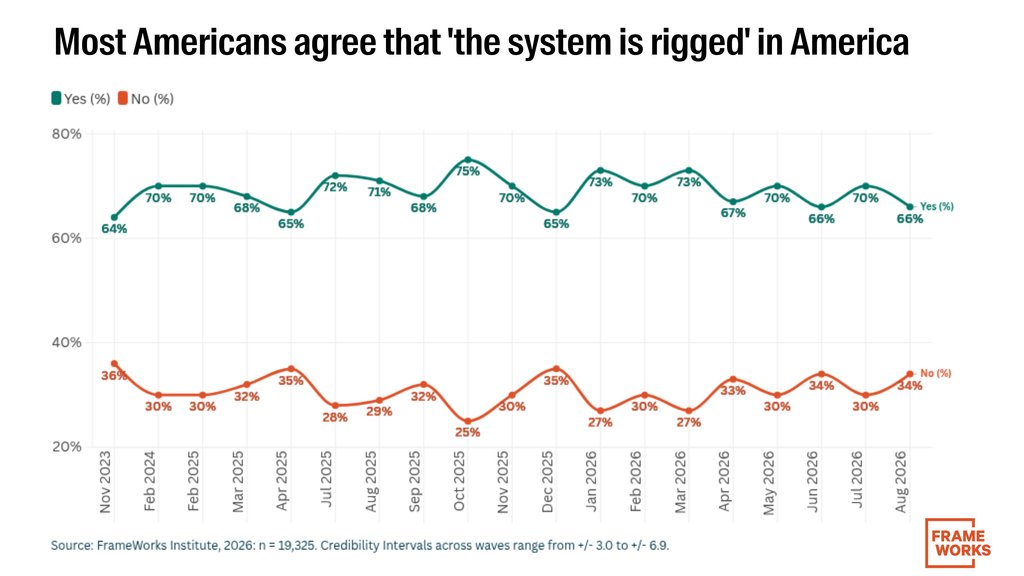
Surveys and focus groups conducted by FrameWorks over the past few years reveal that Americans widely believe the system is rigged to benefit the powerful few at the expense of regular people. The graph below shows how widespread and consistently held this mindset is among Americans. Over the past three years, between two-thirds and three-quarters of Americans have consistently said “yes” when asked, “Do you think the system is rigged in America?”
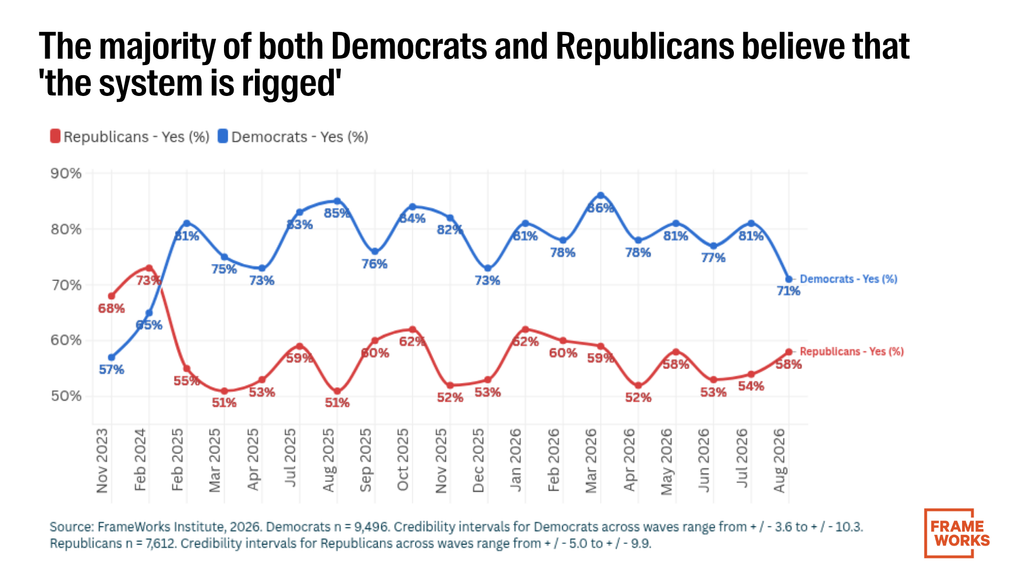
This mindset is shared by majorities of people in both parties.
As of August 2026, 71% of Democrats and 58% of Republicans believe the system is rigged.
The deep dissatisfaction with the existing system underlies growing anti-incumbent sentiment as well as polling showing that anti-system attitudes are driving voter choices. People do not merely disagree with specific policy choices or government decisions being made. They experience the entire system as rigged against them. This leads to a desire for sweeping changes and openness to leaders who echo their frustrations with the system and position themselves as opponents to it.
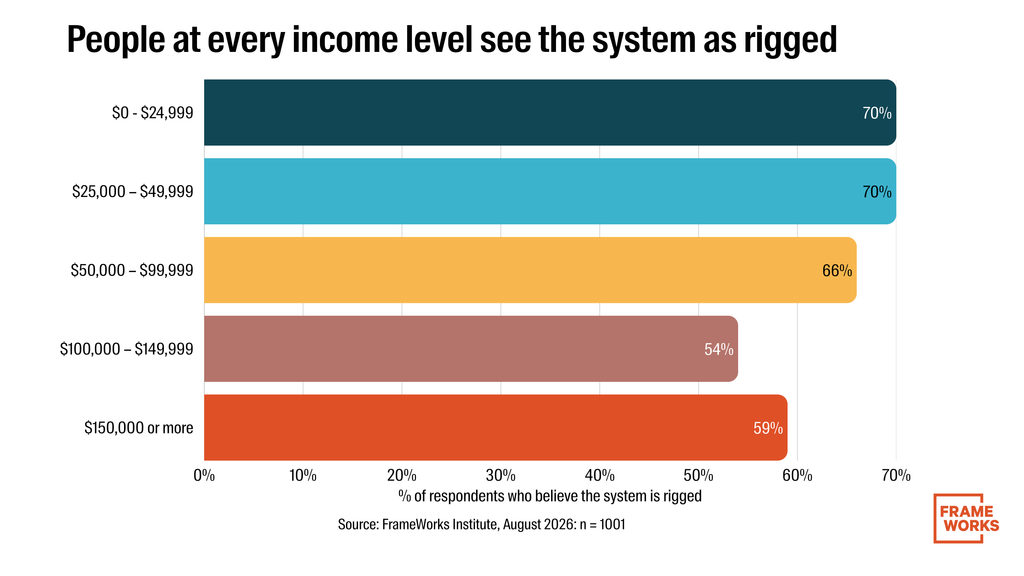
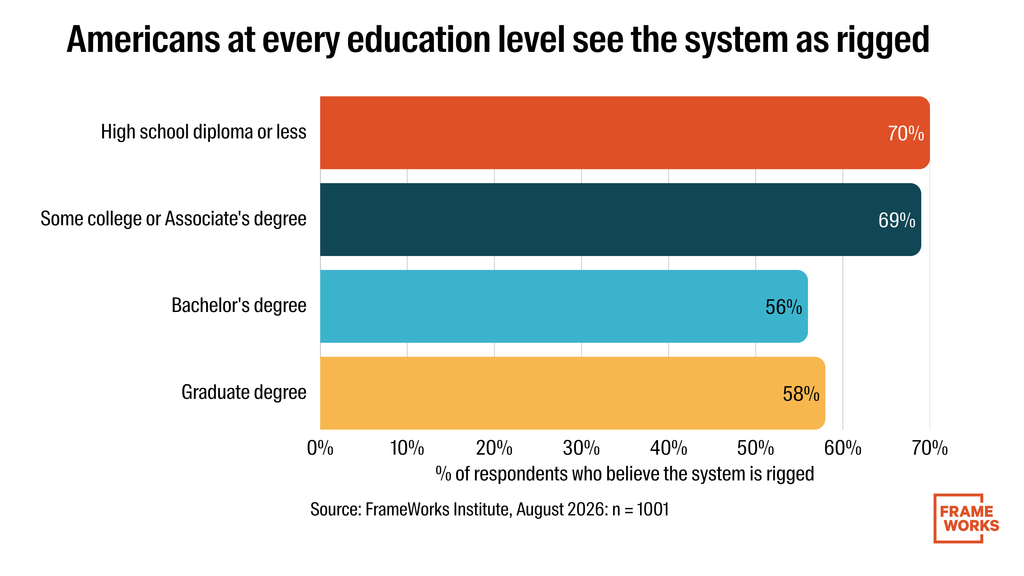
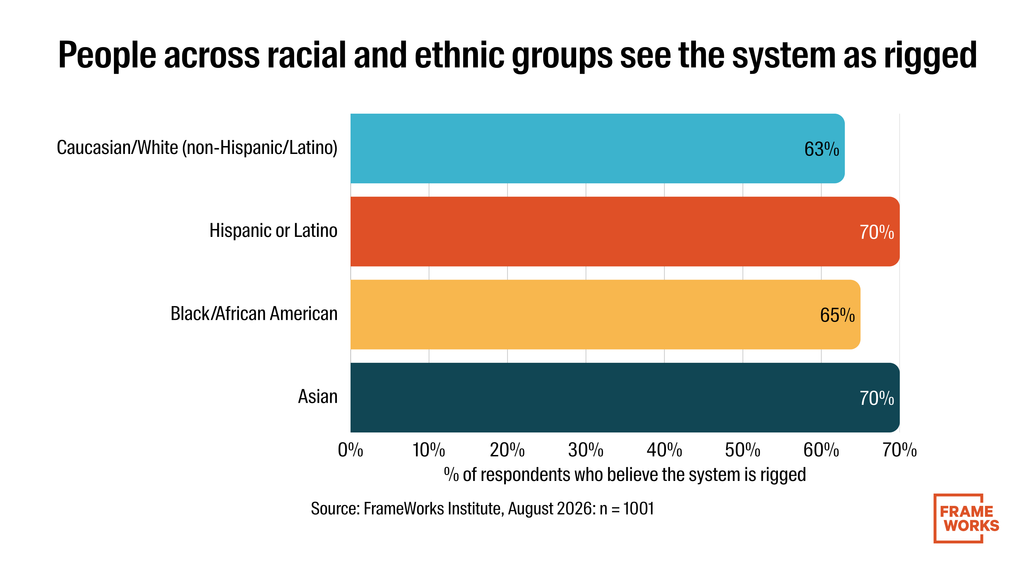
Americans across all demographics see the system as rigged.
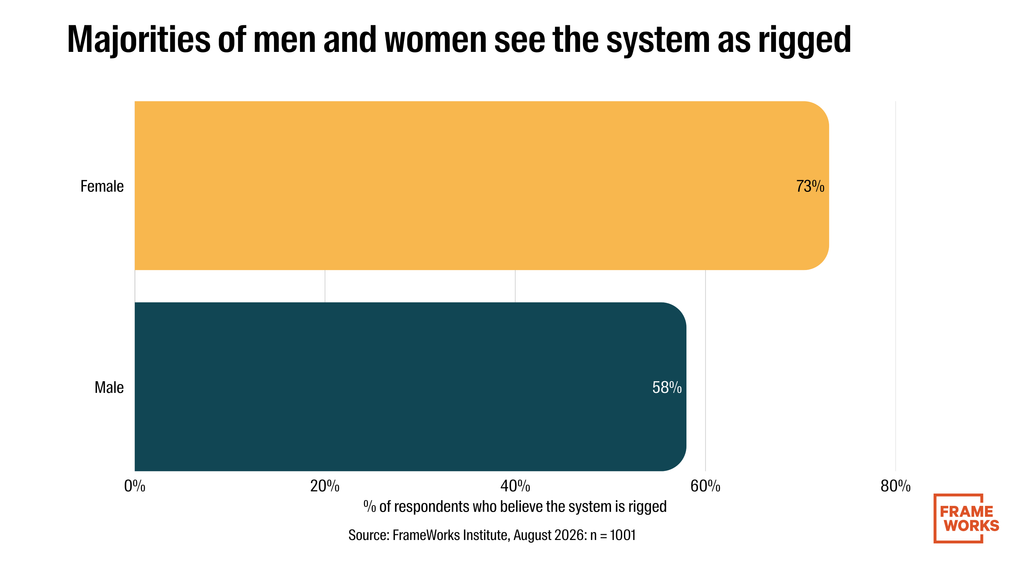
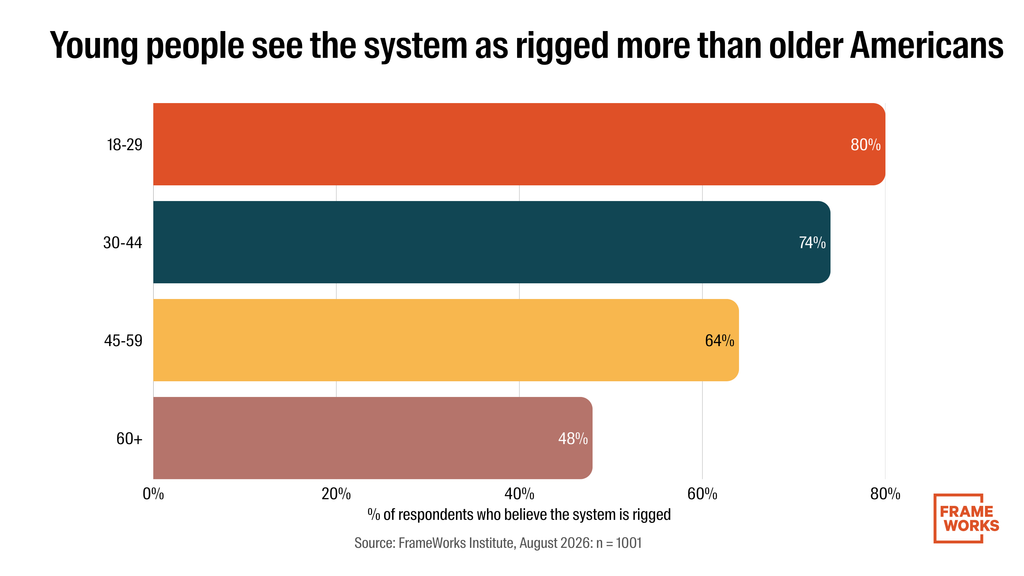
We see that majorities of virtually every group agree that the system is rigged.
Across race, income, education, gender, and age, Americans rely on the system is rigged mindset. These results show just how widespread this way of thinking is. From the perspective of the midterms, it shows that this mindset isn’t just relevant to a particular segment of voters, but forms the backdrop of people’s thinking regardless of their position in society.
Americans want fundamental changes to the political system.
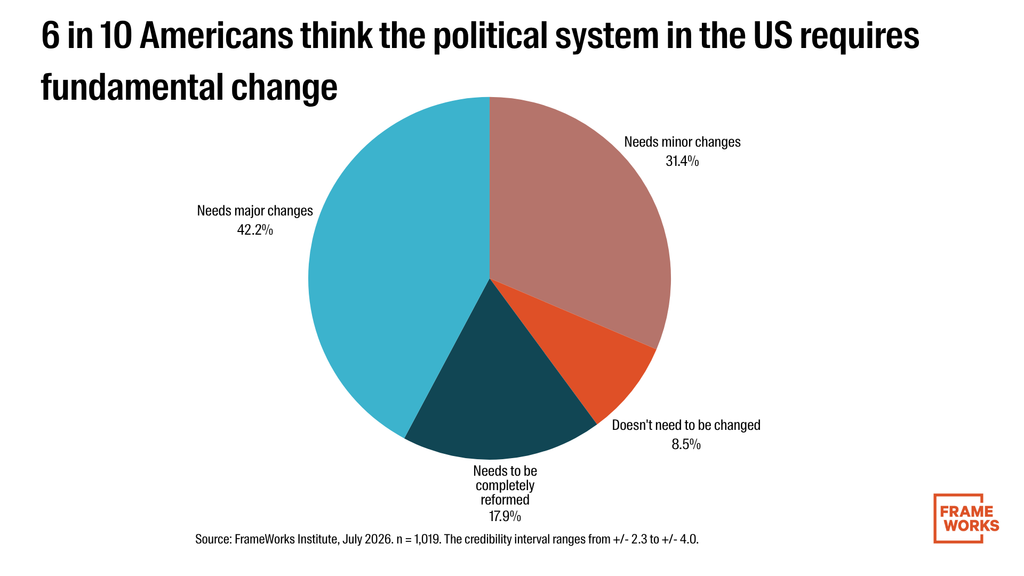
Dissatisfaction with the political system is driving demand for changes to the system. Only 8% of Americans say that the system doesn’t need to be changed at all, and 60% of Americans support major changes to or complete reform of our political system.
Americans blame unresponsive and unrepresentative government for the high cost of living.
Our focus group research consistently finds-–like polling and public opinion research—that Americans are deeply frustrated with the high cost of living. People are widely experiencing the rising cost of living as a crisis.
Yet our focus groups also reveal something that polling often obscures—that Americans see affordability challenges as the result of government’s unresponsiveness and unrepresentativeness. While polling often treats “affordability” and “democracy” as separate issues, most Americans see them as connected. They see lack of affordability as a failure of government to respond to their most pressing concerns.
This connection is reflected in the following direct quotes about cost-of-living concerns from FrameWorks focus groups held in August–September 2026.
“We’re not doing real well. Prices are increasing pretty dramatically, wages are not keeping track with that, depending upon where you are in the country. Housing costs are going up astronomically. And we’ve just got a Congress and an administration that just seems to say, hey, let’s do everything we can to fight and obstruct the other guy, and let’s not care about improving the lives of our constituents.”
(White, man, Republican, age 62) (Aug/Sept 2026)
“I just feel like the way our country is right now, it’s just… it’s not good. Everything’s expensive, and people can barely afford to pay their bills, and not have much left over. And the voting thing, I would say I’m one of the people that… there was a primary recently, I didn’t vote. But the reason why is because […] it’s either a Democrat or Republican, and I’m like, I don’t want to pick either one. I […] I was like, I don’t want either party, so I didn’t vote.” (Latina, woman, independent, age 48)
“The things that you could afford back then, you can’t afford now. We’re seeing it with the food and stuff like that, but even the things we can’t see, like the chips that go into your phone and stuff. Like, things are being tariffed and taxed in a way that we’ve never seen before. So the dollar is worth less than it has ever been in the past, and inflation keeps changing the gap between poor and rich […] And then life expectancy doesn’t get too much higher, because people don’t see themselves living long lives anymore. They see themselves living in poverty and dying in poverty. No one sees a way out, because it’s almost like a mountain that you can’t even climb, you know what I mean?” (Black, man, Democrat, age 18) (Aug/Sept 2026)
The level of concern about election interference varies widely, but most people assume that electoral institutions will hold.
In focus groups conducted in July 2026, participants expressed varying levels of concern about threats to free and fair elections. Some participants were worried that there might be genuine threats to election integrity, while others tended to dismiss these worries.
Even among those who expressed worry, participants tended to personalize the problem, seeing specific individuals in power (e.g.,President Trump) as the source of the threat. They distinguished these irresponsible politicians from underlying institutions, which they assumed have not fundamentally changed.This contributed to an assumption that even if certain individuals try to manipulate results, they won’t succeed because our electoral system will hold.
When different scenarios were raised (e.g., voter purging, refusal to certify election results) participants tended to evaluate these in different ways, with one exception: the possibility of deployment of ICE at the polls was condemned nearly universally. Participants widely understood this as voter intimidation.
On the possibility of ICE being deployed at the polls:
Moderator: “Imagine that on election day, ICE agents or National Guard troops are stationed outside of certain polling places, in specific cities or neighborhoods. What would you think about that?”
Participant: “Voter intimidation, that is voter intimidation, they know what they’re doing, and I know somebody might say, like, well, if they’re legally here, they have nothing to worry about. Well, what if they’re trying to be legally here, and they had something to worry about? I think that’s intimidating and unfair, and the people who put them there know what they’re doing.”
(Black, woman, Democrat, age 28) (June/July 2026)
People widely see the Supreme Court as corrupt and unaccountable.
Focus groups conducted in August–September 2026 found that people see the Supreme Court as part of a rigged system, pointing to the Court’s failure to represent and act on behalf of the people. They talked about the Court as corrupt in both a narrow sense (i.e., bribery) and a broader sense (morally bankrupt and self-serving). People also see the other branches as part of a rigged system that does not sufficiently check the Court’s power. This helps explain the Court’s historically low approval rating. If elections are legally contested and questions go to the Court, this view of the Court will inevitably shape public reactions to decisions.
Moderator: “What if I ask about individual Supreme Court justices – the members that sit on the Court right now. What comes to mind for you?”
Participant 1: “Sellouts.” (Black, woman, independent, age 55)
Participant 2: “I was gonna say corruption.” (White, man, leans Democratic, age 43)
Participant 3: “I was gonna say party tools.” (Asian American, man, leans Republican, age 25) (Aug/Sept 2026)
“We all know how corrupt it is inside, and it goes deep. How it’s appointed, how it’s vetted, everyone’s corrupt there.” (Asian American, woman, independent, age 49) (Aug/Sept 2026)